
WooCommerce and Shopify Stores for Small Businesses
We build and fix online stores for small businesses in the UK and Europe: fast product pages, a short checkout, VAT set up correctly and the payment methods your customers expect, from cards and PayPal to Klarna and iDEAL.
An Online Store Built to Sell, Not Just to Look Good
WooCommerce and Shopify stores are most of what we build, usually for small UK and European shops that have outgrown a catalogue with a PayPal button stuck on the end. A candle maker in Harrogate and a bike parts supplier in Utrecht sell very different things. Underneath, they want the same four: product pages that load fast on a phone, a short checkout, VAT that’s right for wherever the parcel is going, and the payment buttons their customers expect to see.
On this page
Why most small WooCommerce and Shopify stores underperform
Most WooCommerce and Shopify stores we are asked to look at are not badly designed. They look fine on a laptop. The problems show up on a phone, at checkout, and in the admin screens your staff use every morning.
The same issues come up again and again:
- Product photos uploaded at full camera size, so category pages crawl on 4G
- A checkout that forces shoppers to create an account before paying
- Delivery costs hidden until the final step
- VAT shown one way on the product page and another on the invoice
- No Apple Pay, Google Pay or Klarna, so mobile shoppers give up typing card numbers
- Stock counts that drift because nothing talks to the warehouse or the accounts
None of these are hard to fix. They just need someone to check them on purpose, with real test orders, before launch. That is the gap our WooCommerce and Shopify stores are built to close.
It is also why we ask to see your analytics before quoting. Say most visitors are on phones and loads of baskets die at the delivery step. Fine. That’s where the budget goes first.
Choosing between WooCommerce and Shopify
We build on both platforms and have no reason to push you towards one. The right answer depends on your catalogue, your budget for monthly fees and who will run the store once we hand it over.
When WooCommerce makes more sense
WooCommerce sits on WordPress. The code, the customer data and the server are all yours. There is no platform fee on each sale. It suits shops with unusual products, such as made-to-measure blinds or print-on-demand with lots of options, and firms that already have a WordPress site with years of blog content and rankings.
WooCommerce also gives you more freedom with SEO. You control URLs, schema and page speed in ways a hosted platform limits.
The trade-off is maintenance. Plugins need updating and hosting needs to be decent. This is the side of WooCommerce development for small businesses that people underestimate, so we set up updates and backups properly and show you how they work.
When Shopify makes more sense
Shopify is less hassle week to week. It looks after hosting, security and updates, and a new Saturday starter can learn the admin before lunch. Think of a boutique in Brighton or a coffee roaster in Galway: they would rather be packing orders than reading about PHP versions.
You pay a monthly plan and sometimes app fees. If you already have a Shopify store, we also take on fixes and theme work without rebuilding everything. As a Shopify developer UK retailers can speak to in plain English, we will also tell you when an app you are paying for is doing something the theme could do for free.
Which WooCommerce and Shopify stores suit a small catalogue
For a shop with a few hundred products and one person running it, either platform works. The deciding factor is usually who fixes things when they go wrong.
With WooCommerce development for small businesses, we stay on hand for updates. With Shopify, the platform handles most of it.
Larger catalogues change the picture. WooCommerce and Shopify stores both cope with thousands of products, but imports, variations and filters need planning. We map your product data first, so a clothing shop in Leeds with sizes and colours does not end up with a mess of variations.
You also get a short written note comparing WooCommerce and Shopify stores for your case. Every ecommerce website for small business owners we build starts with that note, so you can check it with your accountant or partner before committing.
Six fixes built into our WooCommerce and Shopify stores
All WooCommerce and Shopify stores we launch get the same six checks, whatever the platform. These are the fixes that most often separate a store that sells from one that just gets visits.
- Guest checkout switched on, with account creation offered after payment instead of before
- Delivery costs shown on the product page or basket, not sprung at the end
- Express payments such as Apple Pay, Google Pay and PayPal on mobile
- Images resized and served in modern formats so product pages load quickly
- UK and EU VAT set up with VAT-inclusive prices and correct invoices
- Real test orders placed through every payment method and shipping zone
That last one matters more than it sounds. We have seen WooCommerce and Shopify stores go live with a Stripe account still in test mode and a shipping zone that quoted zero for Ireland. A single afternoon of test orders catches that.
VAT, payments and shipping for UK and European shoppers
Selling from the UK into Europe, or from the Netherlands into Germany and Belgium, brings rules that generic store templates ignore. We set these up as part of all WooCommerce and Shopify stores we build, not as an extra you find out about later.
VAT and invoices
We configure standard, reduced and zero rates where they apply, show prices the way your customers expect to see them and make sure the invoice matches the basket. If you sell into the EU above the distance selling threshold, we set rates per country so you are not charging UK VAT to a shopper in Lyon. Your accountant still signs off the rules, and we make the store follow them.
Payment methods people already use
Card payments through Stripe or Shopify Payments are the starting point. After that it depends on where your customers are.
Dutch shoppers expect iDEAL. Belgian shoppers look for Bancontact. Klarna and PayPal help with higher-value baskets across the UK and Germany.
Shipping zones and rates
We build shipping zones that match how you post things. Flat rates for Royal Mail, weight bands for courier parcels, free delivery over a threshold, and click and collect if you have a shop counter.
It sounds dull. It is also one of the first places a checkout breaks.
An ecommerce website for small business owners who run it themselves
Most of our clients do not have an ecommerce manager. The owner or one member of staff runs orders around everything else. So an ecommerce website for small business teams like that has to be simple to live with, not just nice to look at.
That means order emails that make sense, stock alerts before a best seller runs out and product templates your team can fill in without breaking the layout. We hook up Google Analytics 4 ecommerce tracking and Google Merchant Center. That way you can see what’s selling, and your products turn up on Google Shopping too.
If it saves you time, we’ll plug the store into whatever you already use. Orders drop straight into Xero or QuickBooks. Stock can sync with the warehouse system, and the dull repeat jobs get handed to Zapier or n8n. Friday afternoons involve a lot less copy and paste after that.
We also train whoever will run the store. A recorded walkthrough of adding products, refunding an order and changing a delivery price is usually worth more than a manual. It is a small thing that makes an ecommerce website for small business owners far less stressful in the first busy season.
Want to know how tax classes or shipping zones behave under the bonnet? The official docs are dry but decent: WooCommerce documentation.
Moving or fixing existing WooCommerce and Shopify stores
Plenty of jobs aren’t new builds. Lots of owners turn up with WooCommerce and Shopify stores that work fine but don’t sell like they should. Or they’ve just outgrown the platform.
Before quoting, we audit the current setup.
Sometimes it’s a tiny fix. Two checkout plugins fighting each other, a payment method people expect that isn’t there, a theme loading six fonts for no reason. Other times it’s cheaper to rebuild and be done with it. You get our honest view either way.
Store migrations without losing rankings
When we move a store between platforms, we bring across products, customers and order history. Then every old URL gets a 301 redirect to its new home, so Google doesn’t lose the thread. Product page titles, descriptions and image alt text come across too. This is what protects your Google rankings during the switch, and it is the part rushed migrations skip.
We have moved WooCommerce and Shopify stores in both directions. The process is the same: a full copy on staging, a redirect map you can check, test orders, and a quiet launch window agreed with you, usually early in the week when orders are lower.
Speeding up a slow store
If your problem is mainly speed, we can treat that as its own project. Our WooCommerce speed optimisation service goes through the theme, the plugins, the database and caching. Nothing goes live until we’ve tried it on staging.
How pricing works for WooCommerce and Shopify stores
WooCommerce and Shopify stores vary a lot in scope, so we quote a fixed price after a free discovery call, once we know how many products you have, which countries you sell to and what the store needs to connect to. You can see how our packages are structured on the pricing page.
The whole team designs and builds in-house, led by Umer Shafique. Nothing is passed to a freelancer you have never spoken to.
From first call to launch, a new store usually takes a few weeks. How many depends on how fast the product content comes over. That’s nearly always the hold-up, so start taking photos and writing descriptions now.
After launch you get 30 days of support. If something odd happens with an order or a payment in that first month, we fix it.
Plenty of clients keep us around after launch for odd jobs. A new payment method before Christmas. A landing page for a trade show. More shipping zones once orders start coming in from Scandinavia. Good WooCommerce development for small businesses doesn’t stop at launch. Nor do we.
If you want WooCommerce and Shopify stores from people who’ll put a real test order through before they say it’s done, get in touch and tell us what you sell and where your customers are. We’ll come back with a straight answer on which platform fits, and what a fixed-price build covers.
What We Do
New WooCommerce and Shopify Stores
We recommend the platform that fits your products, budget and team, then build a store your staff can run day to day.
- Platform recommendation
- Product and category setup
- Mobile-first product pages
- Staff training
Checkout, VAT and Payments
A short checkout with the payment methods your customers expect and tax handled correctly for the UK and EU.
- UK and EU VAT rules
- Cards, PayPal, Klarna, iDEAL
- Shipping zones and rates
- Guest checkout
Store Fixes and Migrations
Move an existing store to a new platform or fix the one you have, keeping your products, customers, orders and Google rankings.
- Product and order migration
- 301 redirects for old URLs
- Speed and checkout fixes
- Stock and accounting integrations
What You Receive
Four Steps From First Call to Launch
A written quote before work starts, regular updates in writing, and nothing goes live until you have approved it.
Free Scope Call
We talk through your products, markets and order volume, recommend a platform and send a fixed-price quote.
Store Design and Setup
Design, products, shipping, VAT and payments are set up on a staging store you can review.
Test Orders
We place real test orders with every payment method and shipping zone before launch.
Launch and Training
We go live, connect Google Shopping and tracking, and train your team to run orders.
Case Studies: Online Stores
Projects we have delivered, what we built and what changed for the client.

Car Rental & Fleet Booking Web App | Devsio
High-performance vehicle rental platform with interactive fleet catalog, real-time availability filters, and automated reservation pipelines.
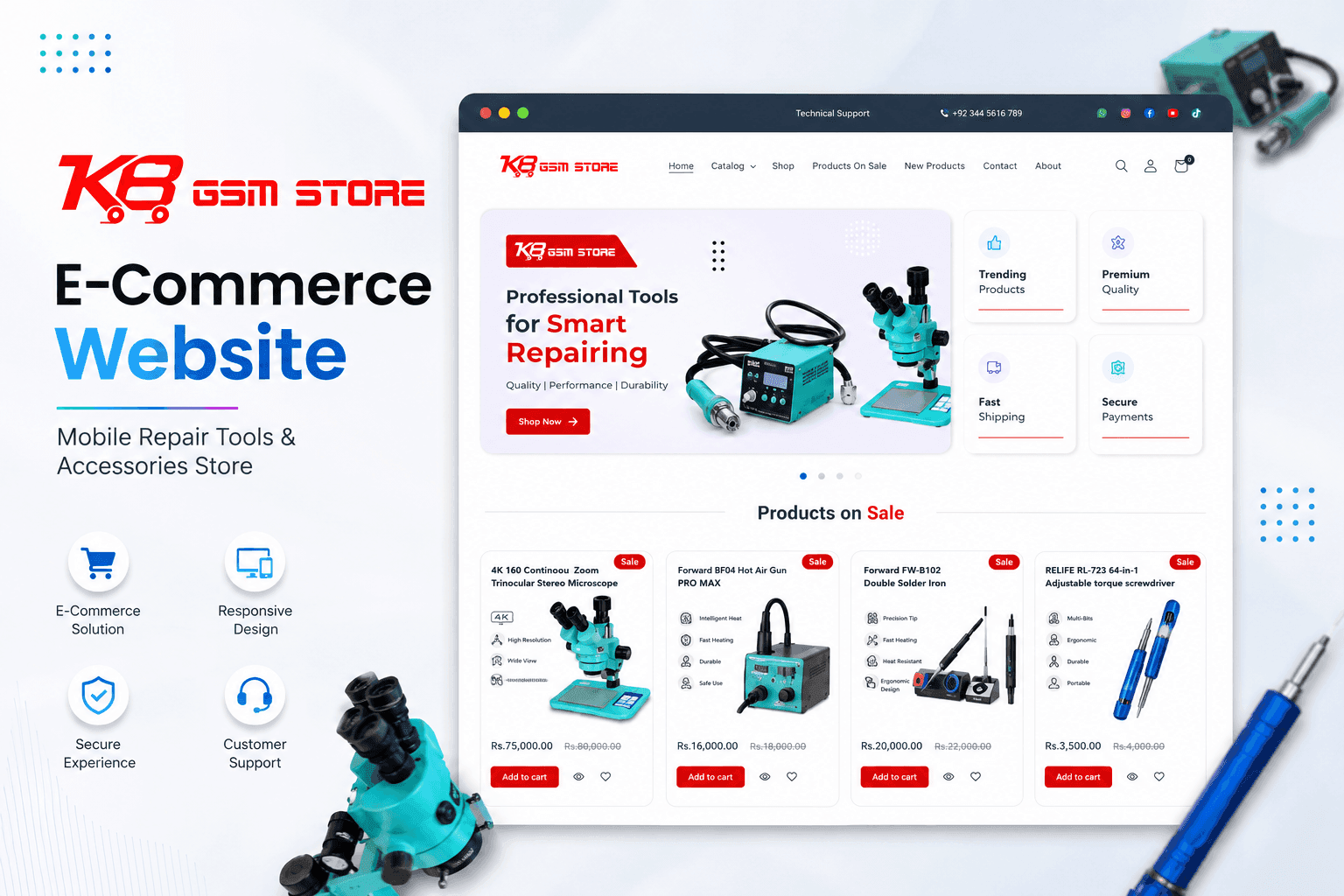
B2B E-Commerce & Inventory Sync | Devsio
Multi-category e-commerce storefront for mobile repair hardware and accessories with real-time SKU search and automated inventory sync.
Guides for Small Business Owners
Practical articles on the problems this service solves, written from real client work.
Why Your Business Doesn’t Show in Google’s Local Pack, and What Actually Moves It
The three map results at the top of a local search take most of the clicks. Here is what the ranking data says decides who appears there, and the order to work through it.
Traffic But No Enquiries? Five Things We Check on UK Small Business Websites
Your analytics show visitors. Your inbox is empty. Here are the five things we check first on UK small business websites, and what the data says about fixing them.
WooCommerce and Shopify Stores FAQs
Ready to get started with WooCommerce and Shopify Stores?
Book a free call and get a written, fixed-price quote. Every project includes 30 days of support after launch.