
Custom Software for Small Businesses That Have Outgrown Spreadsheets
When your team is copying data between spreadsheets, emails and three different apps, custom software pays for itself. We build booking systems, inventory and quoting tools and client portals that fit how your business already works.
Software Built Around How Your Business Already Works
Custom software for small businesses sounds like something only large firms can afford. In practice it is often a single system that replaces four spreadsheets, a shared inbox and a notebook by the till. A plumbing firm in Sheffield tracking jobs on a whiteboard, or a wholesaler in Rotterdam keying orders into two systems, can save hours every week with one well-built tool.
On this page
What custom software for small businesses looks like
Forget the image of a huge enterprise platform. Most of the custom software for small businesses we build is focused and used by five to fifty people. It does one part of the business very well.
Typical projects include:
- A quoting tool that turns a site visit into a priced PDF in minutes
- A job tracker for engineers, with photos, notes and customer signatures
- A stock and reorder system for a shop with a warehouse out the back
- A client portal where customers see their orders, invoices and documents
- A booking system with rules that tools like Calendly cannot handle
Each one is built around how your team already works. We watch the process first, including the workarounds, then design software that removes the double entry.
Where it tends to help most
Custom software for small businesses earns its keep in firms with repeat, rule-heavy work. A cleaning company in Birmingham juggling rotas across forty sites. A car parts supplier in Dublin with trade prices that differ per garage. A tutoring agency in Hamburg matching students to tutors by subject, level and postcode.
In each case, the rules live in someone’s head or in a spreadsheet full of colour codes. Put those rules into software and the whole team can follow them, not just the person who wrote them.
Custom software for small businesses in trades, retail and services
Custom software for small businesses rarely starts from a blank page. It usually starts from the spreadsheet or paper form your team already relies on, because that shows how the work really runs.
For a trade firm in Swindon, that might be a job sheet that becomes a mobile form with photos and a customer signature. For a garden centre in Kent, it might be a stock list that turns into reorder alerts and supplier emails. For a recruitment agency in Leeds, it might be a candidate tracker that replaces a colour-coded workbook.
In each case, bespoke software development means copying the useful parts of the old process and dropping the rest. Staff recognise the fields and the order of the steps, so training takes hours rather than weeks.
We also look for the jobs custom software for small businesses should not try to do. Payroll, for example, is usually better left to Xero or a specialist product, with a simple link between the two. Where a ready-made product already does a job well, we connect to it instead of rebuilding it. Keeping the custom part small keeps the cost of custom software for small businesses under control and makes it easier to maintain later.
5 easy signs your business has outgrown spreadsheets
Spreadsheets are brilliant until they are not. They are flexible, free and everyone knows how to use them. The trouble starts when the business grows and the spreadsheet grows with it, one tab and one formula at a time.
These are the signs we hear most often on first calls.
- The same data is typed twice. An order goes into a spreadsheet, then into Xero, then into an email to the warehouse.
- Only one person understands the system. When they are on holiday, things stall.
- Mistakes cost real money. A wrong price on a quote or a missed delivery date.
- You pay for five apps that do not talk to each other. Each subscription is small. Together they add up.
- You cannot answer simple questions quickly. How many jobs are open? Which customers owe money? What sold last month?
If three or more of these ring true, custom software for small businesses is worth a proper look. If only one does, a better spreadsheet or a Zapier automation might be enough, and we will say so.
Custom software versus off-the-shelf tools
Off-the-shelf products suit standard processes. If your business runs like everyone else’s in your sector, a product built for that sector is usually cheaper and faster to set up.
Bespoke software development makes sense when the way you work is part of why customers choose you. A joinery firm with its own pricing rules. A clinic group with unusual booking patterns. A distributor with contract prices per customer.
The honest trade-off
Bespoke software development costs more up front than a monthly subscription. In return, you stop paying per user, you stop bending your process around someone else’s product, and you own the result. Over three to five years the maths often favours owning the system, but not always. Count the licence fees, the hours lost to workarounds and the errors, then compare that with the cost of custom software for small businesses of your size.
We run through that comparison with you before quoting. Some of our best calls end with us recommending an existing product and a little automation instead.
Bespoke software development that connects to your tools
A new system should not become another island. We connect custom software for small businesses to the tools you already pay for, so data moves once and lands in the right place.
- Xero or QuickBooks for invoices and payments
- Stripe for card payments and deposits
- Google Workspace or Microsoft 365 for email and calendars
- n8n or Zapier for smaller automations around the edges
- WhatsApp for customer updates where your customers prefer it
Where a tool has no ready connection, we use its API or a scheduled export. Your existing data comes across too. We clean and import the spreadsheets you have, so the new system starts with your real customers, products and prices.
Data protection and hosting
Customer data brings legal duties under UK GDPR and EU GDPR. The ICO’s guidance for organisations is a sensible starting point if you want to understand what those duties mean for a small firm.
We host in UK or EU data centres where your data needs to stay, set up user roles so staff only see what they need, and keep an audit trail of who changed what. Your legal adviser should check the wording in your privacy notice, but the technical side is handled.
Questions to ask before commissioning bespoke software development
Before you sign with anyone, including us, get clear answers to these. They save arguments later.
- Who owns the source code, and when does ownership transfer?
- Where is the data hosted, and can I export it in a standard format?
- What is in the first release, and what is left for later?
- How are changes priced once the build has started?
- Who fixes bugs after launch, and for how long is that included?
- Can another developer take over the code if I need them to?
If a supplier is vague on any of these, treat that as a warning. Good bespoke software development is boring on paper: clear scope, clear ownership and a clear exit.
How we keep a custom software project on budget
Most custom software for small businesses that goes wrong does so because the scope keeps growing. We avoid that by building in stages and agreeing the first release in writing.
Start with the smallest useful version
The first release of a bespoke software development project covers the one process that hurts most. For a trade business that might be quoting and job tracking. For a shop it might be stock and reorders. Everything else goes on a list for later.
You see progress every week or two on a private staging site. Your team uses that first version with real data. Their feedback shapes what comes next, which is far more reliable than guessing everything up front.
What it costs
Custom software for small businesses is priced by scope: how many screens, how many user types and how many connections to other tools. You get a fixed price for the first release after a free call. Our pricing page shows typical starting points.
The biggest cost driver is usually not the screens. It is the rules behind them: pricing logic, approval steps and exceptions. The clearer those rules are before we start, the tighter the quote for your custom software for small businesses project.
A focused first release usually takes four to eight weeks. Later stages are quoted separately, so you are never committed to a big budget before you have seen the software working.
If your needs are retail-specific, such as tills, barcodes and receipts, our POS and retail billing software service may be a closer fit.
Why choose Devsio for custom software for small businesses
Devsio is run by Umer Shafique. Before building software for other companies, he spent years in a trading business, so he knows what it is like when stock, invoices and staff all compete for the same afternoon.
Our team designs and builds everything in-house in Islamabad, and we build custom software for small businesses in trades, retail, wholesale and professional services. There is no subcontracting, and the people on your discovery call are the people who write the code.
- Fixed prices. Each stage is quoted in writing before work starts.
- You own the code. Source code, database and hosting accounts transfer to you on final payment.
- Plain English. Updates explain what changed and why, without jargon.
- Time zone overlap. Our afternoons cover UK and European mornings, and calls are booked in your time.
We keep bespoke software development small on purpose. Fewer features that work well beat a long list of half-finished ones. A system your team uses every day is worth more than an impressive one they avoid.
After launch
We move your data across, train your team and fix anything that comes up in the first month. After that, some clients book a monthly support plan and add features as the business grows. Others run the system on their own for years. Either way, nothing is locked to us.
The best custom software for small businesses fades into the background. Staff stop talking about the system and start talking about the work again.
We also document the system as we go, with short written guides and screen recordings. If a new manager joins in two years, they can learn it without calling us.
Thinking about custom software for small businesses like yours? Book a free call and bring the spreadsheet you trust least. We will map how the work runs today and tell you honestly whether a custom build is worth it.
What We Do
Internal Tools and Portals
Replace the spreadsheets and email chains your team relies on with one system that fits your process.
- Quoting and job tracking
- Inventory and stock control
- Client and supplier portals
- Staff roles and permissions
Booking and Ordering Systems
Let customers book, order and pay online in a way off-the-shelf tools do not handle for your business.
- Online booking and scheduling
- Custom order flows
- Deposits and payments
- Automatic reminders
Connecting Your Existing Tools
Your new system talks to the accounting, payment and email tools you already pay for, so data is entered once.
- Xero and QuickBooks
- Stripe and PayPal
- Google Workspace and Microsoft 365
- Import from existing spreadsheets
What You Receive
Four Steps From First Call to Launch
A written quote before work starts, regular updates in writing, and nothing goes live until you have approved it.
Process Mapping
We sit down with the people who do the work and map how the job runs today, including the workarounds.
Fixed-Price Proposal
You get a written scope for the first release, with price, timeline and what is left for later.
Build in Stages
We release working parts every week or two on a staging site, so you test with real data as we go.
Launch and Support
We move your data across, train your team and fix anything that comes up in the first 30 days.
Case Studies: Custom Software
Projects we have delivered, what we built and what changed for the client.

Car Rental & Fleet Booking Web App | Devsio
High-performance vehicle rental platform with interactive fleet catalog, real-time availability filters, and automated reservation pipelines.
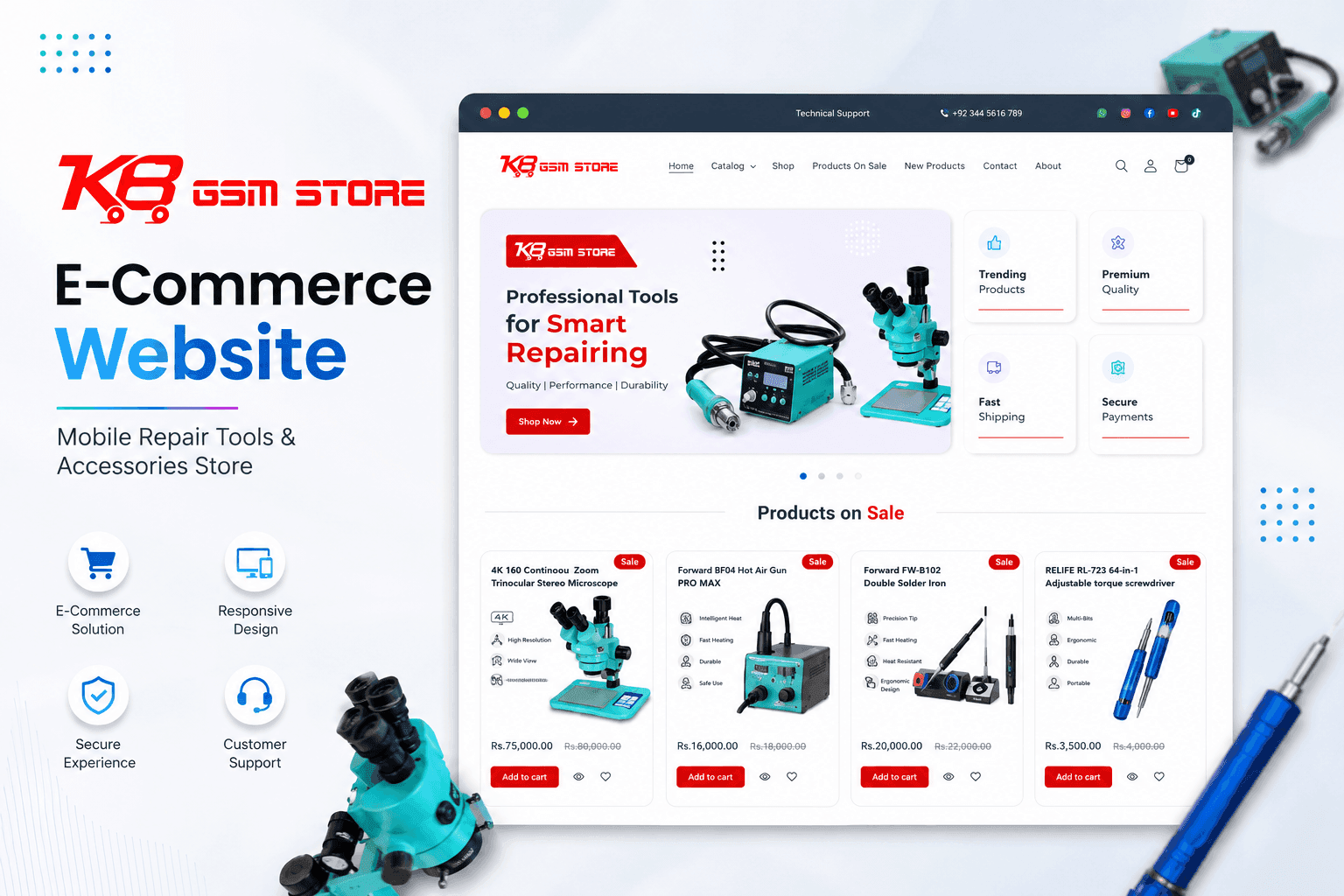
B2B E-Commerce & Inventory Sync | Devsio
Multi-category e-commerce storefront for mobile repair hardware and accessories with real-time SKU search and automated inventory sync.
Guides for Small Business Owners
Practical articles on the problems this service solves, written from real client work.
Why Your Business Doesn’t Show in Google’s Local Pack, and What Actually Moves It
The three map results at the top of a local search take most of the clicks. Here is what the ranking data says decides who appears there, and the order to work through it.
Traffic But No Enquiries? Five Things We Check on UK Small Business Websites
Your analytics show visitors. Your inbox is empty. Here are the five things we check first on UK small business websites, and what the data says about fixing them.
Custom Software for Small Businesses FAQs
Ready to get started with Custom Software for Small Businesses?
Book a free call and get a written, fixed-price quote. Every project includes 30 days of support after launch.