
Crawl, schema, speed and content architecture for UK small firms whose site is technically present but commercially invisible.
Technical SEO for UK small businesses means making the site easy to crawl, easy to understand and worth ranking: fixing crawl budget, building one linked schema graph, hitting Core Web Vitals targets and giving each commercial intent exactly one page. Retainers start from $199 a month or PKR 15,000 a month.
Crawl budget: why 404 loops suppress the crawl rate
Google does not crawl a site for free. It allocates a finite amount of crawling to each host, and that allocation responds to what it finds. When a large share of requests end in 404s, redirect chains or soft 404s, the crawl rate for the whole site is reduced. Pages you actually want indexed get visited less often, and new pages can sit unindexed for weeks.
This is the failure mode that hides best, because every page a human clicks looks fine. It usually starts with a rebuild or a platform migration: old URLs are deleted instead of redirected, an internal link generator points at a slug that no longer exists, or a filter creates thousands of combinations nobody meant to publish. We start with the raw evidence: server log files, the XML sitemap set, robots.txt, Search Console’s crawl and page-indexing reports, and a full crawl in Screaming Frog.
Then we map every broken URL to a live destination with a single-hop 301. Not a blanket redirect to the homepage, which Google treats as a soft 404, and not a redirect chain that wastes a fraction of the crawl on every hop. The sitemap is pruned to indexable, canonical URLs, and robots.txt is checked against what the business actually needs crawled.
Schema graph engineering: one entity, many pages
Most sites add structured data as isolated blocks: one Service block on a service page, one FAQPage block on the page with FAQs, no relationship between them. Search engines and AI answer engines then have to guess whether the service, the organisation and the page describe one business or three unrelated things.
We build one graph instead. The organisation is a single ProfessionalService entity with a stable @id and a known address, phone number and URL. Each service page adds a Service node whose provider points at that same organisation @id. Each answer page adds FAQPage, each article adds BlogPosting, and every page carries a BreadcrumbList that ties it to the site hierarchy. The @id values are what hold it together: one entity, many pages, all referencing each other.
For a UK small business this matters most in local and commercial results, where rich results and answer engines are deciding which of three similar firms gets shown. It also makes the site legible to AI assistants that quote sources, because a clean graph gives them a factual record to quote rather than a page to interpret.
Core Web Vitals: the 3 numbers that decide page experience
Google scores page experience on three metrics with published thresholds: Largest Contentful Paint under 2.5 seconds, Interaction to Next Paint under 200 milliseconds, and Cumulative Layout Shift under 0.1. These are targets we engineer towards, not outcomes we can guarantee, because the final field data depends on your visitors’ devices and network.
The work is unglamorous and mostly front-end plumbing. Images are converted to WebP or AVIF, resized to the dimensions actually displayed, and lazy-loaded below the fold, with the hero image preloaded so it is not the bottleneck. Cache headers are set so returning visitors and the CDN serve static assets without hitting the origin. Critical CSS is inlined so the first screen paints without waiting for the full stylesheet, and non-critical scripts are deferred.
Third-party tags are the usual culprit on small business sites: a chat widget, a heatmap tool, three tracking pixels and a review plugin, each adding a separate connection and main-thread work. We audit what each one contributes, remove or delay what does not earn its cost, and route the rest through a tag manager with consent control. Cloudflare sits in front for caching, compression and edge delivery.
E-E-A-T for a 6-person team: author entity, case studies and evidence
Experience, expertise, authoritativeness and trust are not a checklist you bolt on at the end. For a team of six, the advantage is that the people doing the work are the people you can name. We structure the site so that is visible rather than implied.
That means a real author entity for every article, tied to a named person with a role and a background, not a generic “admin” byline. It means service pages written from delivered work, with case studies that show the problem, the build and the outcome. It means evidence where evidence exists: screenshots, crawl exports, Search Console date ranges, and photographs of real projects. Where we do not have the asset, we mark the gap instead of inventing a metric.
Devsio was founded in 2017 by Umer Shafique, who still manages Star Electric Enterprises in Saddar, Rawalpindi alongside the agency. That experience is why our fixing order starts from operational failure rather than an audit template. The team and its background are on the about page.
Content architecture: one page per intent, 301 consolidation and pruning
Cannibalisation is the quiet cause of a page that will not rank. Two or three pages target the same phrase, link to each other with similar anchors, and split whatever authority the site has. Google picks one, often the wrong one, and the others hover on page three.
We map the queries the business needs to win, then assign each commercial intent to exactly one page. Where duplicates exist, the strongest page becomes the survivor, the others are merged into it, and the retired URLs get a single-hop 301 so any links or rankings carry across. Pruning follows the same logic: thin pages that exist only to fill a menu are removed or merged, which raises the average quality of what remains.
Internal linking is then rebuilt around the structure: service pages link to their case studies and to related services, articles link up to the service they support, and no page is more than three clicks from the homepage. For UK firms with town or county pages, each location page gets a genuine reason to exist: local projects, local phone numbers, local coverage detail. Templated pages with the town name swapped are not a local strategy.
Measurement: Search Console, GA4 and a monthly report in plain English
We do not report on vanity impressions. Search Console gives the query and page data: what is indexed, what is excluded and why, which queries are gaining position, and where click-through is weak relative to position. GA4 tells us what happens after the click, provided conversions are configured properly: form submissions, phone taps, WhatsApp taps and booked calls, each as an event with a value attached.
Each month you get a short report that says what changed, what we did, what it produced and what is next, with the underlying screenshots and date ranges attached.
Technical SEO pricing: from $199/mo or PKR 15,000/mo
| Service | From | Local pricing | Timeline |
|---|---|---|---|
| SEO and Google Ads retainer | $199£157/mo | PKR 15,000/mo | Monthly |
| Small business website (if the site needs rebuilding first) | $399£315 | PKR 35,000 | 3–5 weeks |
The retainer covers technical fixes, content architecture, schema maintenance and reporting. Paid ad spend is separate and paid directly to Google. Where a page needs copywriting beyond the agreed scope, it is quoted per page before work starts, and the figure appears on the invoice as a separate line. Payment is by Stripe card or bank transfer, in USD, GBP, EUR, AED, SAR or PKR at the rate on the invoice date.
3 cases where a technical SEO retainer is the wrong spend
If your site has fewer than a few hundred visitors a month and the business is sustained by referrals, the constraint is demand, not crawling; paid search or a better service page will move the needle faster. If the site is a single landing page with no content plan, there is not yet enough structure to optimise; build the pages first. And if nobody can approve copy or supply project detail for a month at a time, the retainer will produce recommendations rather than changes. We would rather tell you that on the first call.
Proof: what changed on the Servixer campaign
Servixer came to us with bounce on organic visits, crawl budget being wasted on old 404 loops and no page-one rankings for its core service searches. We fixed discovery first, mapping legacy URLs to live destinations, then built the schema graph and pruned thin pages before writing commercial pages for B2B buyers in the US and UK.
The case study reports +340% organic traffic, 42 page-one commercial keywords and 5.2× inbound leads. Those figures are labelled illustrative on our site, and we keep that label here. The verifiable part is the method: a crawl cleanup, a linked graph, a pruning decision and one strong page per commercial intent. You can read the full Servixer technical SEO case study for the detail.
Seven questions UK owners ask about technical SEO
What is technical SEO, in one paragraph?
It is the engineering underneath a site: whether search engines can crawl it, whether they understand what each page means, whether pages load fast enough to satisfy page-experience signals, and whether the site’s structure points at the pages that make money. Content and links still matter, but technical SEO removes the reasons they fail.
How much does technical SEO cost for a UK small business?
Our retainer starts at $199 a month or PKR 15,000 a month. That covers the technical backlog, schema maintenance, content architecture and reporting. One-off audits, migrations and large content builds are quoted separately, with the scope and price agreed in writing before work begins.
Will fixing schema get us rich results?
Schema makes you eligible for rich results; it does not guarantee them. Google decides what to display, and it can choose to show nothing. What a clean graph does reliably is remove ambiguity about what your business is, where it operates and which page answers which question, which helps both classic search and AI answer engines.
Can you work on a Wix, Squarespace or Shopify site?
Partly. On hosted platforms we can fix metadata, structured data, content architecture, redirects and internal linking. Some server-level fixes, such as cache headers and log-file access, are not available on those platforms, so we say which items are out of reach before you commit to a retainer.
How long before we see results from a technical SEO retainer?
Crawl and index fixes show in Search Console within days to a few weeks. Ranking and traffic changes take longer and depend on competition, content quality and how much authority the domain has. We report the leading indicators monthly so you can see movement before revenue follows.
Do we need to give you server or Search Console access?
Search Console and Analytics access are needed, plus read access to the hosting or CDN for cache and log work. We use delegated users where the platform supports them, never shared passwords, and access is removed at the end of the engagement on request.
What happens if our site is rebuilt during the retainer?
It is the best time to have the work done. We specify the technical requirements before the build starts: redirect map, canonical rules, schema graph, image pipeline, cache headers and Core Web Vitals budget. That prevents the 404 loops and schema gaps that migrations usually create, and it is why we work alongside the UK web design team on rebuilds.
Start with Devsio’s free audit, then decide
The free UK website audit covers the crawl, indexing, schema and Core Web Vitals picture in plain English, with the three fixes we would do first. Take it to another agency if you prefer; the findings are yours either way.
Get Devsio’s technical SEO findings this week
Send your domain and the commercial queries you care about. We will reply within 24 hours with what we would fix first, what it costs and how long it takes.
What We Do
What You Receive
Four Steps From First Call to Launch
A written quote before work starts, regular updates in writing, and nothing goes live until you have approved it.
Case Studies:
Projects we have delivered, what we built and what changed for the client.

Alvi Transport: Car Rental Booking Website
A booking website and fleet app that moved Alvi Transport off phone calls and WhatsApp logs, so customers can see which cars are free and reserve online.
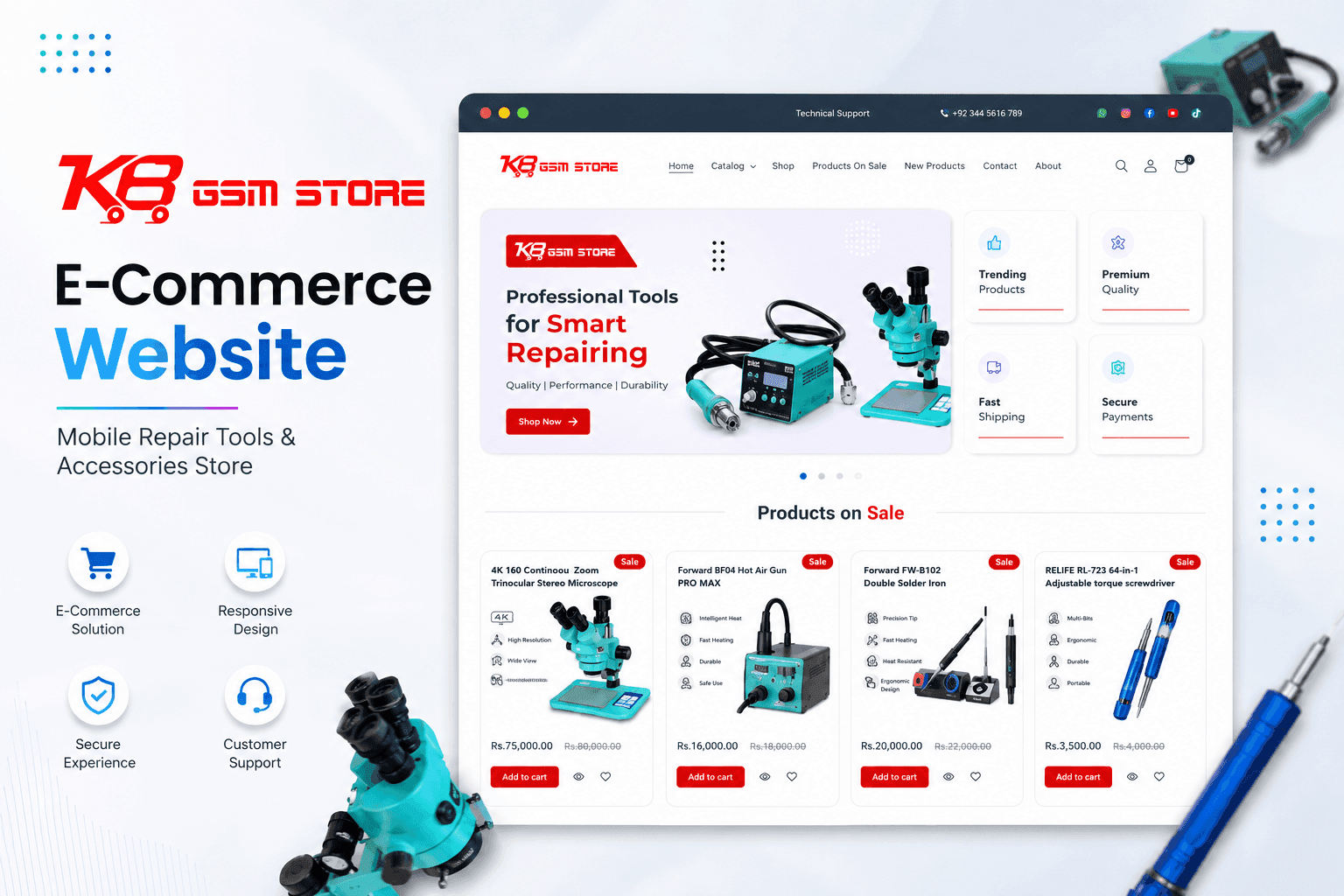
KB GSM: B2B Ecommerce Development for a Phone Parts Wholesaler
A trade store for mobile repair parts and accessories, with quick SKU search and stock levels that update themselves instead of being keyed in by hand.
Technical SEO & Content Architecture for UK Small Businesses FAQs
Ready to get started with Technical SEO & Content Architecture for UK Small Businesses?
Book a free call and get a written, fixed-price quote. Every project includes 30 days of support after launch.