

Digital payments in Pakistan have crossed a line that most shopkeepers have not caught up with yet. The State Bank of Pakistan's Quarterly Report on Payment Systems for Q2 FY26 puts digital payments at 92% of retail payment transactions, up from 88% a year earlier. Of 3.4 billion retail transactions in October to December 2025, 3.1 billion were digital.
Now the number that should worry you. Within Raast, the instant payment system, person-to-person transfers ran at 603 million transactions. Person-to-merchant transfers ran at 33.6 million.
Your customers have moved to digital payments. Most shops have not. That gap is the whole story. The change arrived at the customer end and stopped dead at the counter.
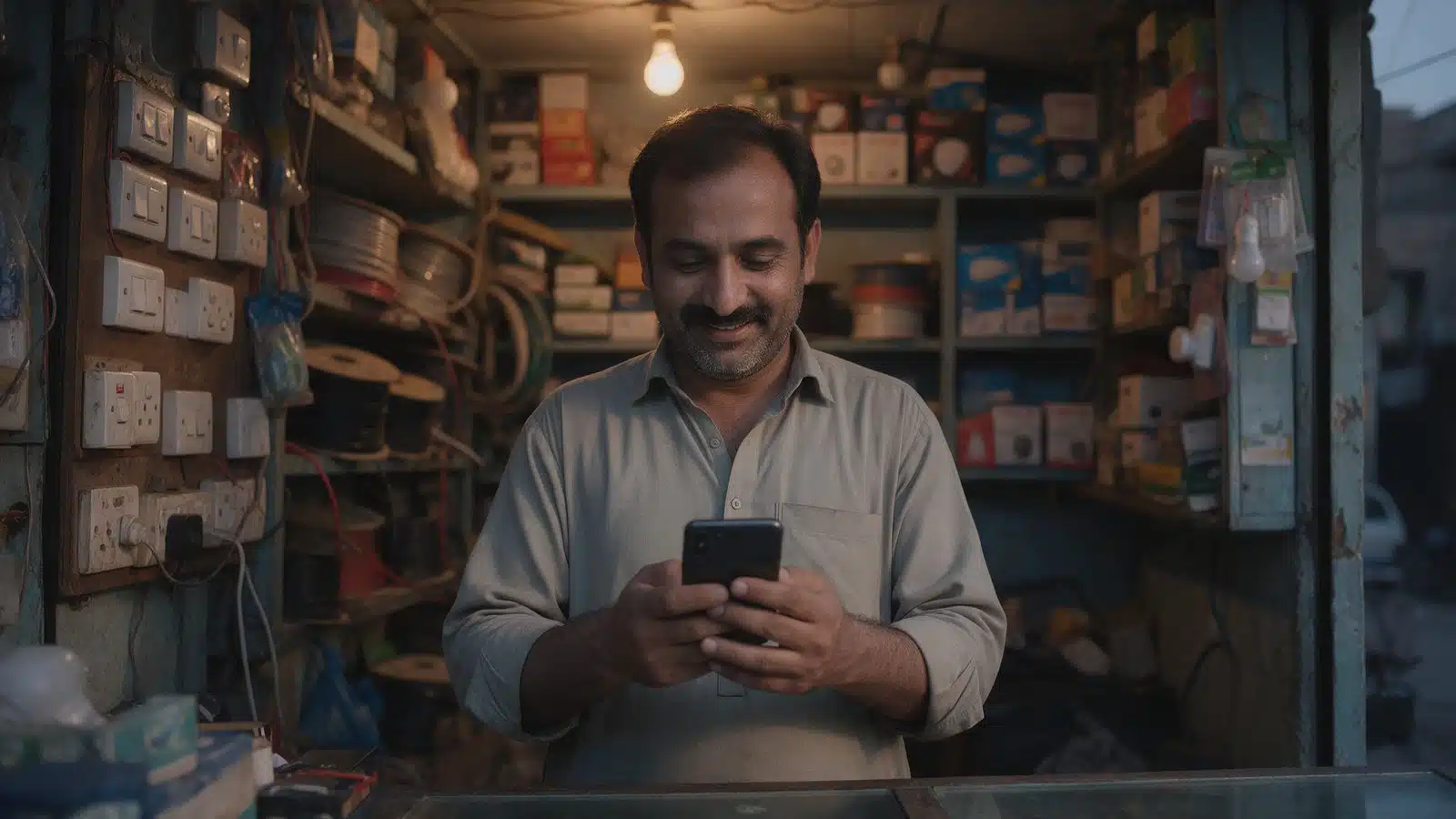
I manage a retail counter in Saddar, Rawalpindi, so this isn't theory for me. Below is what the numbers mean for a small shop, what to set up first, and how to stop digital payments turning your evening close into a second job.
On this page
- What does the 92% digital payments figure mean for a small shop?
- Why is person-to-merchant so far behind person-to-person?
- What should a small shop set up first?
- Do digital payments mean giving up cash on delivery?
- Setting up a Raast QR without the headaches
- Fake screenshots, and how to stop them
- Fees and settlement: what to ask your provider
- Taking payment for WhatsApp orders
- What breaks when payments go digital and the back office does not?
- Getting your counter staff on board
- Collecting credit accounts through digital payments
- What different shops should expect
- Mistakes I see at the counter
- What this looks like done properly
- Keeping records your accountant can use
- A 90-day plan
- Where to start this week
- Related reading
- If you are not sure what your shop needs
What does the 92% digital payments figure mean for a small shop?
It means the habit has already changed and you are the one who has not caught up. Not that 92% of your counter sales are card or wallet.
Someone paying their electricity bill, sending money to family, topping up a phone or buying from a marketplace is doing it on an app. Mobile apps alone carried 2.6 billion transactions, about 83% of all digital payments, worth roughly Rs40 trillion. The muscle memory of opening an app to pay is fully formed.
Then that same person walks into a shop and is told cash only. They pay, because they have to. But the friction registers, and next time there is an alternative that does not have it, they take it.
Why is person-to-merchant so far behind person-to-person?
Because P2P needs nothing from the shopkeeper and P2M needs a decision. That is most of it.
The rest is the reasons owners really give for holding back on digital payments, and they are not stupid ones. Merchant discount rates eat into thin margins. Settlement takes a day or two when cash is available tonight. A documented digital trail feels like an invitation for questions later. And the person on the counter has to learn something new during a busy afternoon.
I run a retail business alongside Devsio, so none of that reads as an excuse to me. It reads as a real set of costs. The point is only that they now have to be weighed against a cost on the other side, which is customers who expected to tap and could not.
What should a small shop set up first?
A Raast QR code, because it costs you nothing and settles instantly into your account. Of all the options for digital payments, it's the one with no downside.
Not a card machine. Not a payment gateway. A printed QR next to the till, accepted by every major banking app in the country. If you do nothing else after reading this, do that.
After that, in the order that usually makes sense:
Most shops jump straight to the last one, spend money on a gateway integration, then discover the orders were never going to arrive that way.
- A JazzCash or Easypaisa merchant account, since a large share of your customers hold a wallet rather than a bank account
- A card terminal, but only once you can see from your own numbers that people are asking for it
- An online payment gateway, and only when you are selling online rather than taking orders on WhatsApp
Do digital payments mean giving up cash on delivery?
No, and treating it as a choice is the mistake.
Cash on delivery still carries a large share of Pakistani ecommerce because it solves a trust problem, not a payments problem. You can read the State Bank of Pakistan's payment systems reports for the national picture, but the reason at the doorstep is simpler than any statistic. The customer does not doubt the app. They doubt whether the parcel will contain what the picture showed.
So the way to reduce your COD share is not to remove the option. It is to remove the doubt: real photographs of the actual item, a returns policy someone can find without hunting, a phone number that a human answers, and reviews from customers who can be verified. Then offer a small discount for paying in advance and let people choose.
Removing COD before you have earned the trust just removes the order. Digital payments in advance grow when doubt shrinks, not when you take options away. If you sell online, the checkout itself is usually the bigger leak, and the reasons people abandon it are well documented rather than mysterious. I went through those in detail in this breakdown of why shoppers abandon a WooCommerce checkout, and most of it applies here without changing a word.
Setting up a Raast QR without the headaches
It's a small job, but a few details decide whether digital payments work at the counter or become a source of arguments.
That last point matters more than it sounds. If the person at the counter can't confirm the money has landed, they'll either hold the customer up or hand over goods on trust.
- Get the merchant QR from your own bank, linked to your business account rather than a personal one, so the money and the records stay separate.
- Print it large enough to scan from a metre away, and laminate it. A curled paper QR under the glass counter gets ignored.
- Test it with a small payment from two or three different banking apps before you rely on it.
- Make sure the payment notification reaches a phone the counter staff can see, not just the owner's phone in his pocket.
Fake screenshots, and how to stop them
Every shopkeeper who takes digital payments has seen this. A customer shows a screenshot of a "successful" payment, takes the goods, and the money never arrives. Sometimes it's a mistake. Sometimes it isn't.
The rule is simple and it should be written down: goods go when the notification arrives on the shop's own phone or account, not when the customer shows you their screen. It feels awkward for the first week. Every shop goes through that week. Regular customers get used to it quickly, and the ones who object are usually the ones you needed the rule for.
For bigger sales, especially on credit accounts settling up, check the bank app itself before you mark the invoice paid. Digital payments are safer than cash in a lot of ways, but only if someone confirms them properly.
Fees and settlement: what to ask your provider
Card terminals and wallet merchant accounts all come with terms. The headline fee is only part of it. Before you sign anything, ask these and write down the answers.
Then compare the fee on digital payments against what you'd lose by turning the customer away, not against zero. That's the fair comparison.
- What's the fee per transaction, and does it differ between debit cards, credit cards and wallets?
- How long does settlement take, and does it happen on weekends and public holidays?
- Is there a monthly rental or a minimum volume?
- What happens with a disputed or reversed payment, and who pays for it?
- Are there daily or per-transaction limits that could affect a big sale?
Taking payment for WhatsApp orders
A lot of small shops in Pakistan sell more on WhatsApp than on any website. That's fine. You don't need a gateway to take digital payments for those orders.
Send your Raast details or wallet number with the order confirmation, and ask for advance payment on anything made to order or delivered outside your area. For regular local customers, cash on delivery can stay, because you already know them. Record which method each order used, same as at the counter.
When WhatsApp orders become a real share of the business, that's the point to look at a proper online store with a payment gateway. Not before.
One more thing on WhatsApp orders. Keep a simple log of each order, the amount, the payment method and the date the money arrived. Customers who pay in advance by transfer sometimes send the money days before they collect, and without a log it's easy to lose track of who has paid for what. A single shared sheet on the shop phone is enough to start with. Digital payments only make life easier when the record keeping keeps up.
What breaks when payments go digital and the back office does not?
Your reconciliation, and it breaks quietly.
With cash, the drawer is the record. Once digital payments arrive across four channels, the day's takings live in a bank statement, a JazzCash dashboard, an Easypaisa dashboard and a card settlement report, and none of them line up with your sales register without someone doing the work.
This is the part nobody warns owners about. You add a payment method to make life easier for customers and add half an hour to somebody's evening, every evening.
The fix is to have the billing system record the payment method on the invoice at the point of sale, so the day closes with a split you can check against each provider in minutes. If your books currently live in a package rather than a system built round your counter, it is worth reading my comparison of Busy, Tally, QuickBooks and going custom before you spend anything.
Getting your counter staff on board
The owner decides to accept digital payments. The counter staff are the ones who make it work or quietly kill it. If a salesperson finds a transfer slower than cash, he'll steer customers towards cash, and you'll never see it in any report.
If you've got more than one person handling money, give each one their own login on the billing system. It isn't about distrust. It's so that when a figure doesn't match, you can find the invoice in a minute rather than an hour.
- Show every person on the counter how to confirm a payment on the shop's phone or account. Five minutes each.
- Put the Raast QR where the customer pays, not where the owner sits.
- Make recording the payment method part of raising the bill, not a separate step at night.
- At the end of each shift, the person closing checks digital receipts against the bills, the same way they'd count cash.
Collecting credit accounts through digital payments
Most shops I know run a credit book. Regular customers, contractors, the school round the corner. Collecting that money has always meant a phone call, a visit, or waiting until they happen to come in. Digital payments change that more than they change the counter.
Send the balance on WhatsApp with your Raast QR or wallet number underneath. A contractor on a site in Bahria Town can settle from his phone the same afternoon instead of promising to drop by next week. Once digital payments make paying easy, a lot of people simply pay sooner.
The catch with digital payments is matching. A transfer arrives with a name and an amount, and sometimes the name is his brother's or his company's. Ask regulars to put the invoice number or their shop name in the payment note. Then mark the account paid only once the money shows on your side, same rule as at the counter.
Keep the credit book and digital payments in one place if you can. A transfer that came in by Raast but nobody crossed off is how disputes start. Do it at the evening close, not at month end when nobody remembers who paid what.
What different shops should expect
The national figures hide big differences between trades and areas. Your own customers are the only data that really matters, but the patterns are fairly consistent.
Pharmacies and grocery stores
Lots of small baskets, often from regular customers. A Raast QR and a wallet account cover most of the demand. Card terminals help with larger monthly shops, particularly in areas like F-7 Markaz or DHA.
Electrical, hardware and building materials
Bigger tickets, contractors on credit, and a lot of bank transfers already. Here the shift to digital payments is less about the counter and more about receivables. Recording who paid what against which invoice is the whole job.
Restaurants and cafés
Card and wallet demand is high, especially from younger customers and families at weekends. Speed at the till matters, and so does splitting a bill between two payment methods.
Wholesale in the old bazaars
In Raja Bazaar or the older markets of Saddar, cash and credit still dominate between traders. That's not changing overnight. But the retail customers walking in off the street increasingly expect to pay by app, and a QR costs you nothing.
Mistakes I see at the counter
Each one is easy to avoid at the start and annoying to fix later. Digital payments punish sloppy record keeping harder than cash ever did.
- Taking payments into a personal account, then trying to separate business and home money at month end.
- Letting the notification go only to the owner's phone, so the counter can't confirm anything.
- Signing up for a card terminal before checking whether customers want one.
- Recording the payment method only for some sales, which makes the whole report unreliable.
- Treating a screenshot as proof of payment.
What this looks like done properly
A customer pays however they want. The counter records which method it was. The day's report shows cash, wallet, card and bank transfer as separate lines that each reconcile to their own source. Nobody stays late. That is what it looks like when the back office has kept up with digital payments.
That is not an expensive system. It is a decision made at the right time, before four payment methods and a spreadsheet have turned into somebody's second job.
Keeping records your accountant can use
A digital trail worries some owners, as I said earlier. The practical answer is that clean records protect you far more than they expose you. When every sale carries a payment method and every digital receipt matches an invoice, your accountant can close the month quickly and answer questions with evidence rather than guesses.
Keep business receipts in a business account. Download the monthly statements from each provider and file them with the sales report for the same month. If your category also has to report invoices to the FBR in real time, the payment method field becomes part of a bigger job, which I've covered separately.
A 90-day plan
If the four steps below feel like a lot at once, spread them out.
By the end of it you'll know what your customers really want, and your close will take the same time it always did.
- Month one. Raast QR at the till, notifications on the shop phone, payment method recorded on every bill.
- Month two. Add a wallet merchant account if customers ask for it. Start the end-of-shift check of digital receipts against bills.
- Month three. Look at the numbers. How many customers asked for card? How much came through each channel? Decide on a terminal or a gateway based on that, not on a sales pitch.
Where to start this week
- One. Print a Raast QR and put it where customers can see it, not under the counter.
- Two. For one week, ask every customer who pays cash whether they would rather have paid another way. Write down the answers.
- Three. Add a payment method field to your invoice, even if it is a column in a register for now.
- Four. Only after those three, decide whether a card machine or a gateway is worth the fee.
Related reading
- If your category has to report invoices to the FBR in real time, the payment method field is only part of the job: what FBR POS integration really involves.
- Once every sale is itemised, the first report worth building is the ageing one: dead stock is the most expensive thing in your warehouse.
- Why I run a counter as well as an agency, and why it changes the advice: nine years in electrical trading and what it taught me about software.
If you are not sure what your shop needs
If you're weighing up digital payments for your shop, tell me how customers pay you now and how the day gets closed. I will tell you which of this is worth doing for a business your size and which is a distraction, and I will say plainly if the right answer is a QR code and nothing else.
Free consultation at devsioservices.com/contact. You can also read about our custom POS and billing software, our WooCommerce and Shopify store builds for when you're ready to sell online, and how fixed-price quotes work on the pricing page.
Frequently asked questions
What does a small shop need to start accepting digital payments?
A business bank account, a QR code or payment link from your bank or a wallet provider, and a simple way to record each payment against the sale so your cash book and stock stay in line.
Should a small shop start with QR payments or a card machine?
QR payments are usually the cheaper and quicker place to start, because customers already pay that way from their banking and wallet apps. A card machine makes sense once enough customers ask for it.
How do digital payments connect to billing and stock?
The simplest route is a POS or billing system that records the payment method on each invoice. That keeps daily reconciliation quick and stops digital sales going missing from the books.
Related guides
- FBR POS integration for Pakistani retailers. What it really costs and what breaks.
- Custom software development for small businesses. When it pays off and how to buy it.